
★ THE ODD & THE WONDERFUL
Food, fellowship, memories, mischief, and the things we never forget
Not everything in the life of a church is solemn. Some of it is delicious. Some of it is very funny. Some of it is the kind of thing that makes no sense to anyone who wasn’t there and makes perfect sense to everyone who was.
This section is for those things. The samosa eaten in haste before the service ends. The dog in the pew. The boy with two wives. The milk that nearly curdled at Easter. The man combing what remained of his hair under the big tree.
These are not footnotes to the life of Richmond Town Methodist Church. In their way, they are the heart of it.
✞ QE1 — FOOD & FELLOWSHIP
THE CHURCH KITCHEN CHRONICLES
What was served, who made it, and why it still comes up in conversation
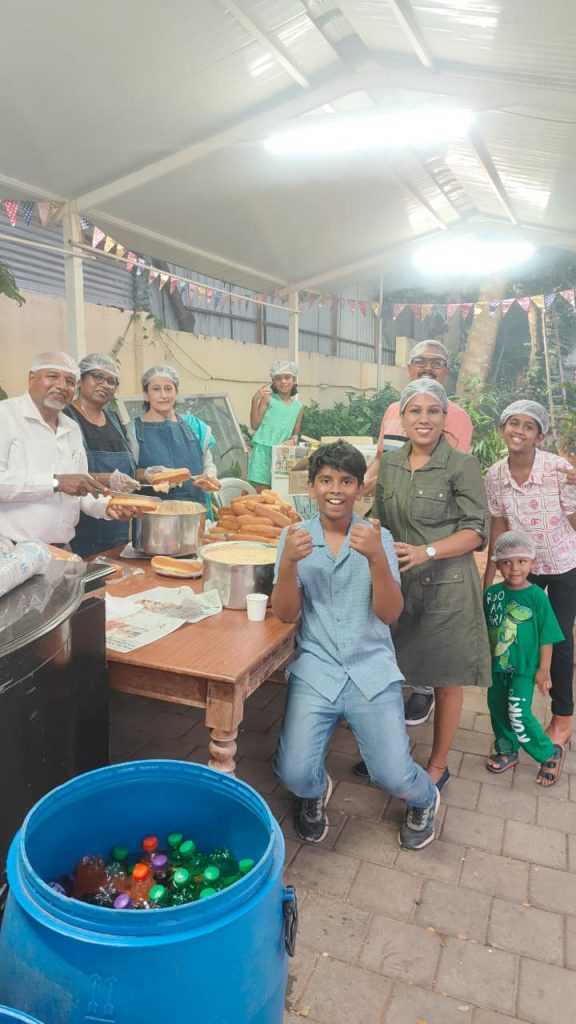
Ask members of Richmond Town Methodist Church what they most associate with the church, and a striking number of them — alongside the hymns, the sermons, the Sunday school, the choir — will mention something they ate there.
This is not incidental. Food at RTMC has always been more than sustenance. It has been the occasion for the fellowship that the formal service creates and the informal gathering sustains.
The Post-Service Tea and Coffee
More members name the post-service tea or coffee than any other food tradition.
Bob Nathanael: “The post-service tea and coffee is a good way to connect with people of the church and continue the fellowship every Sunday.”
Sudhir Joglekar: “It would be hard to beat the classic post-service coffee.”
Shilpa Das captures what actually happens in those twenty minutes: “Those simple conversations after the service often turned into moments of laughter, encouragement, and friendship.”
The tea is not the end of the Sunday morning. It is its continuation — the moment when the formal gives way to the personal, when the congregation stops being an audience and becomes a community.
“Let’s not rush home — let’s have one more cup of tea and keep talking!”
— Overheard after a Sunday service
The Samosa Question
If the post-service tea is the most consistent food tradition, the samosa is its most beloved individual item.
Ravi David: “Samosas, any day!”
Rachel Shatananda names “samosa, cake, and coffee after service.”
Saraswathi Priyadarshini’s three-year-old son Steve arrived at church not for the sermon but for the “masosas” served with coffee after the service.
He had the right priorities.
The Great Christmas Dinner
Christmas dinner is a grand occasion.
Benjamin Stephen names it simply: “The Christmas Dinner.”
Peter M. Paul goes further: “The Christmas Fellowship Dinner is a tradition that I hope lives on. Many memories over the years of spending time with people across generations.”
Praveen Prasanna gives it its full glory:
“Christmas church fellowship dinner biryani.”
— Praveen Prasanna
Five words that contain a complete sensory memory.
The Easter Sunrise Breakfast
The Easter Sunrise service has its own food tradition.
Felix Jeevaneson: “the coffee and biscuits after the Resurrection Day Sunrise service.”
Winston Ashwal names “buttermilk and Easter bun.”
Peter M. Paul adds a detail that puts the food in its proper context: after the sunrise service, the youth would stack all the chairs — partly because it meant they could then go to Hotel Sarovar for breakfast once the work was done.
The Barbecue Nights and Other Specialities
Pastor Vivek Gundimi names a more recent tradition: “The Barbecue Night on every fifth Sunday evening after the Sing Song worship service.”
Shilpa Das confirms the chicken upma at the men’s fellowship and Independence Day breakfast.
And Usha Sundaresan names a speciality that has never been replicated:
“Mrs. Radha Sundaramony’s Keema Upma, which she would make for the WSCS food sale. Haven’t tasted the same anywhere else.”
“Christmas church fellowship dinner biryani.”
— Praveen Prasanna — a complete memory in five words
✞ QE2 — STORIES FROM THE CONGREGATION
THE CHOIR’S GREATEST HITS (AND MISSES)
Memorable, amusing, and entirely true stories from Sunday mornings past
We asked for memorable or amusing stories from Sunday services, choir rehearsals, and church events.
We said names could be withheld. Most people named names anyway.
Saved by a Pinch — A First-Time Confession
The most complete story in this section comes from Rachel Hongal, who asks us to note that it is being told here for the very first time.
Rachel Hongal — Former Member, 1965–1985
Full disclosure: nobody has ever heard this story — until now.
Neegal Noronha and I were on coffee duty for the Easter sunrise service — simple job, we thought. Milk, coffee, sugar, done.
Then, mid-heating, the milk started to break. Not curdled yet, just teetering right on the edge; that telltale grainy shimmer creeping in told us disaster was seconds away.
We stared at the pot in pure panic — sunrise minutes away and zero idea how to pull it back from the brink.
That’s when Aunty Lazaro stepped in, the way she always did. If something went sideways in that kitchen, she was the one people quietly looked for — the person whose calm alone made you feel like the problem was already half-solved.
She took one look at our milk on the verge and, without missing a beat, said:
“Pinch of baking soda. It’ll hold.”
I sprinted to the pastor’s residence, knocked like it was an emergency — it was — and ran back clutching a box of baking soda like treasure.
One pinch, a stir, a held breath — and the milk steadied right back, smooth as ever. Sugar went in next, coffee right behind it, and within minutes we were pouring cups like nothing had ever gone wrong.
By the time the congregation filed in, nobody had a clue how close they came to Easter milk soup.
All these years, the secret has held tighter than the milk did — until today.
And credit where it’s long overdue: Aunty Lazaro saved that Easter morning, just one of the many quiet miracles she’s remembered for.
The Night the Jesus Slept In
Eva Sukumar
All-night practice for the Easter Sunday Sunrise service. The youth go home for a quick rest before the dawn service.
The young man playing the Resurrected Jesus in the shadow play did not turn up. He had fallen asleep at home.
This was not, theologically speaking, ideal.
She offers two more.
Eva Arulmani, as VBS class teacher, supplied VBS badges to her class during inspection to ensure full marks, having obtained extras from the VBS office — which happened to be her home.
The system, one might say, was working as intended.
And:
“Eva tripping over a cello and damaging it at a Praise Singers rehearsal.”
Sometimes the story is complete as it stands.
The Laptop That Froze Mid-Sermon
Rev. Dr. Vivek Gundimi
I remember preaching during the second morning service when my laptop, which I was using to refer to my sermon notes, suddenly froze and would not scroll.
For those few moments, I was surprisingly nervous — something that had never happened to me in all my years of preaching.
I simply told the congregation that my laptop had stopped working and that I would continue from the Bible text.
In that moment, I sensed the Spirit reminding me:
“Speak.”
So I did.
Looking back, I realised that no one seemed to notice any awkwardness except me.
He is still faithful to take over when anything interrupts.
The Car, the Choir, and the Missing Fingertip
Usha Sundaresan (nee Cornelius)
It happened in the late 1970s, after choir practice. My father, George Cornelius, was the conductor. The car was full.
Mrs. Janet Egbert had her hand through the open window at the back, holding the rim. Someone slammed the door.
Janet Aunty’s finger got caught.
We all got out. We could see that the top of one finger was missing. Someone had the bright idea of looking for the missing piece. We naturally did not find it.
Aunty was rushed to hospital.
What happened did not stop Aunty from continuing to sing God’s praises.
That final line is the point of the story. It is not really a funny story. It is a story about the kind of person Janet Egbert was.
The Baby, the Crawl, and Miss Fritchley
Kamala Rachel Kripavathi Noronha
“Miss Fritchley felt her feet get warm and wet. It was my baby, who had crawled to her.”
This story requires no elaboration.
It is perfect at nine words.
A Wedding Verse, Unbeknown to the Bride
May Whittington (Samuel)
“Unbeknown to me, at my wedding, the choir sang the very verse — Proverbs 3:5–6 — which God had given me to confirm that I was marrying the right person. I had not told anyone. They sang it anyway. I have never forgotten that morning.”
Some coincidences are too specific to be coincidences.
Uncle Sukumar and the Wrong Note
Benjamin Stephen
I had joined to sing bass when the morning choir was being led by Miss Fritchley and then by Mr Thomas Paul.
Uncle Muttiah and Uncle Sukumar Samuel were pillars of the bass line. I was put between them.
If we were singing the Call to Worship or a Hymn and I sang a wrong note, Uncle Sukumar would simply stop singing until the “Amen.”
No words. Just silence, until the piece was over.
The most effective correction known to church music.
The Bass Part That Was Not a Bass Part
Aural Shatananda
“Singing an octave lower, thinking it was the bass part. Getting called out for it.”
This is an experience shared by a significant proportion of the male members of every church choir in history.
Aural Shatananda has the courage to name it.
The Cricket Match That Went Too Far
Viji and Priya
In a cricket match between the Youth and the Methodist Men, one of our youth fractured the arm of one of the Men with his bowling.
The Methodist Men may have had questions about the definition of “friendly.”
Loudest in the Room
Shams Stallone
VBS Sunday.
I had to recite a Bible verse.
I was the loudest.
Three sentences.
A complete character portrait.
✞ QE3 — THINGS FOUND IN THE CHURCH
OBJECTS, CORNERS, AND THE GROUNDS
The things we walk past every week and only notice when they’re gone
We asked members to name an object, feature, or corner of the church building and grounds that holds a special memory.
What emerges is a map of the church as its congregation has experienced it — not from the front, but from everywhere.
The Cross and the Stained Glass
The Cross returns in two distinct forms.
Ravi David names simply: “The Cross.”
Prema Hall is more specific: “The beautiful and decorative big Cross on the stained glass panel in the centre of the main part of the church.”
Shilpa Das: “The altar. Every time you go to the front, kneel down and pray — trust me, I have seen miracles.”
The Hammond Organ, the Old Piano, and the Original Altar
Niranjan Noronha named Miss Jean Fritchley playing beautiful hymns on the Hammond organ as his most vivid memory of RTMC.
He also names something else:
“I very much miss the sanctity and sacredness of the church altar that was originally there before the rebuilding in the late 1980s. That altar, though much smaller, had a sense of aesthetics that was very comforting and inspiring.”
Two things are gone.
Both are still present in memory.
Stephen’s Hall — In Memoriam
Stephen’s Hall is named by Florence Michael, Sheila William Joseph, Viji and Priya, Pamela John, Rachel Shatananda, Eva Sukumar, Benjamin Stephen, and Peter M. Paul:
“I have fond memories of the old Stephen’s Hall. We had VBS and Sunday School classes there.”
It appears with such frequency, and such uniformity of affection, that its absence registers as genuine grief.
The building is gone.
The memory of it is not.
The Trees
The trees of RTMC’s grounds occupy an extraordinary amount of congregation memory.
The tamarind tree is named by Eva Sukumar, Aural Shatananda, and Smita Noronha.
The tree in the centre of the compound with its cement bench is named by Rachel Shatananda and Mercy Sarita Moganti.
Grace Veena Bunyan names the silver pine and the gladiolus flower bed.
Dorothy Deena Theodore remembers growing up under those trees.
Under one of them, Usha Sundaresan recalls, the almost bald Mr. Eric Staggs was once found with a comb.
The Balcony — Old and New
Bob Nathanael names simply:
“The balcony.”
Peter M. Paul gives it its proper due:
“I have very fond memories of attending church services sitting in the balcony of the old church building. It had only a few pews and allowed for quiet reflection.”
The old balcony and the new balcony are different spaces.
What was lost and what was kept says something about every act of rebuilding.
The Choir Pew and the Vestry
The choir side of the church appears in the memories of Oniel Samuel, Sunitha Gokavi, Sunil Gokavi, Lipsita Sahu, and Kamala Rachel.
Usha Sundaresan describes the vestry where the choir gathered before the service:
“One of the pastors would pray and then we would walk into the church through the door next to the altar. The vestry was also the library, with a lot of music anthem books.”
A library of anthems in a vestry: the serious musicality of an earlier RTMC, quietly documented.
The Altar Cloth from Japan
While working in Japan, I asked my mother if she wanted me to bring her back anything special.
But she selflessly said she wanted nothing for herself — only to bring an altar cloth for the church.
It was so typical of her giving heart to think only of a gift for the church, making it a memory for me that I will treasure forever.
That altar cloth, carried all the way from Japan to India, still holds a quiet piece of her devotion.
— Rachel Hongal
These pieces were compiled from congregation responses to the Grace & Growth questionnaire, 2025–26. Names have been used with permission; anonymised contributions are marked accordingly.
Richmond Town Methodist Church • Bangalore • 1875–2025
