
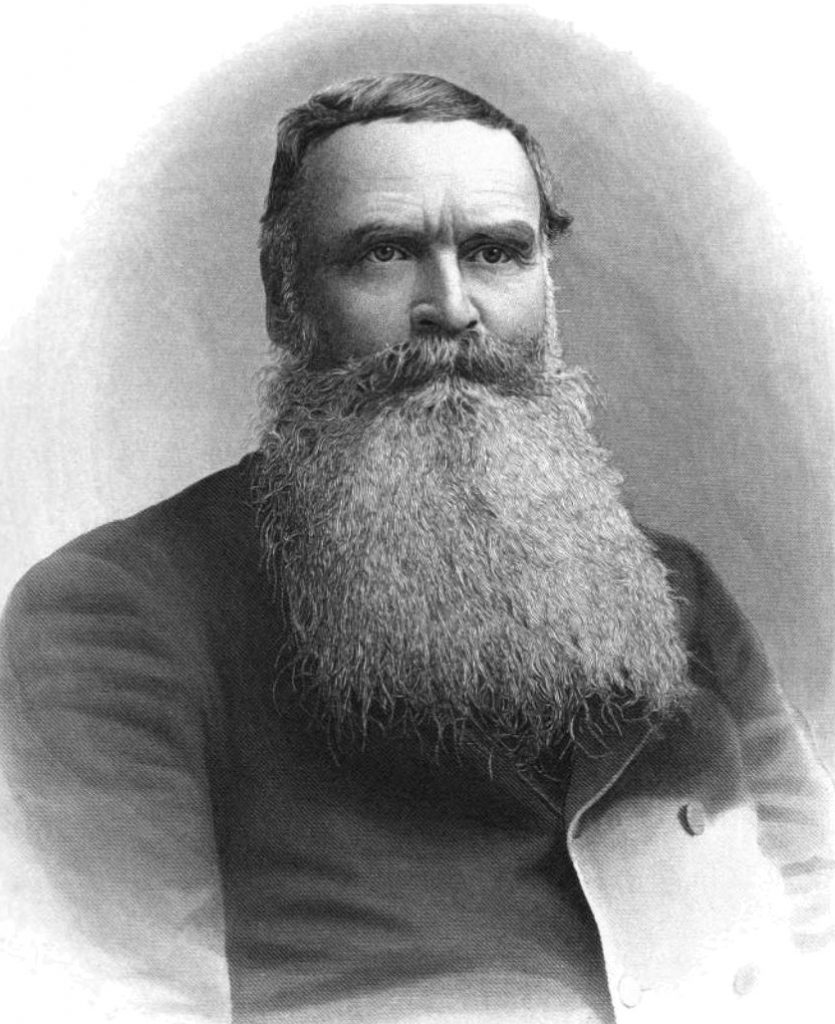
✞ THE MAN WHO FOUNDED THIS CHURCH
Man on a Mission: William Taylor
1821–1902 • Evangelist • Church Planter • The man behind Richmond Town Methodist Church
By Bishop S.V. Sampath Kumar • Methodist Church in India
“I am not ashamed of the Gospel, because it is the power of God that brings salvation to everyone who believes.”
Romans 1:16 — the verse that drove William Taylor across five continents
I have been connected to Richmond Town Methodist Church since I was a teenager. I worshipped here. I was formed here. And for as long as I can remember, I have been drawn to the question of how this church came to exist at all — who built it, and why, and what they believed it was for.
The answer to that question is a man named William Taylor. He was an American evangelist from Virginia who arrived in Bangalore in 1875 and founded this congregation. He had already, in the five years before he reached us, established Methodist churches in Bombay, Poona, Calcutta, and Madras. Richmond Town Methodist Church was the fifth in that sequence. We were not, in his mind, a destination. We were part of a movement.
Taylor fascinated me as a young man and continues to fascinate me. Not primarily because of what he built — though what he built is remarkable enough — but because of the conviction that drove him. He was a man who genuinely believed that the Gospel was the power of God, and that this belief had practical consequences. It meant you got on a ship and went. It meant you stood in drawing rooms and market squares and hospital wards and preached. It meant you did not rest until the people in front of you had been given the chance to make a personal decision about Jesus Christ.
As we mark 150 years of this church, I want to introduce him to you properly. Not as a historical figure, but as the man whose vision we are still, whether we know it or not, living inside.
Virginia to the World: A Life Surrendered
William Taylor was born in Virginia in 1821, into a family that moved from the Presbyterian Church to the Methodist Church during his childhood. But his faith, as he was the first to acknowledge, did not simply transfer to him through inheritance. He had to find it for himself.
He described his conversion in his own words, and the description is vivid enough that I have always remembered it: he heard a coloured girl repeat part of the testimony of a coloured man who had received forgiveness of his sins. That testimony, connecting with the Word of God he already knew, became the moment of faith for Taylor. “I found the basis of faith,” he wrote, “and was led to seek and receive Jesus as my Saviour.”
“Hearing a coloured girl repeat part of the experience of a coloured man who testified that he had received forgiveness of his sins and connecting that testimony for Jesus with the Word of God, I found the basis of faith and was led to seek and receive Jesus as my Saviour.”
William Taylor, on his own conversion, in his own words
I think about that moment often. The most consequential act of Christian witness in the history of this church — the act whose eventual outcome was a Methodist congregation on Kingston Road in Bangalore in 1875 — was an unnamed coloured girl repeating someone else’s testimony. Taylor heard it. It was enough.
This is how the Gospel works.
From that conversion, Taylor went on to forge one of the most extraordinary missionary careers of the nineteenth century. He preached in California during the Gold Rush. He went to Australia, to South Africa, to South America. By the time he arrived in India in 1870, Taylor had already earned a considerable reputation across the worldwide Methodist community. At forty-nine years old, he was a man who showed no signs of slowing down.
India, 1870: A Field Hidden in Plain Sight
When Taylor arrived in India in 1870, he saw what others had overlooked. The British colonial enterprise had scattered English-speaking communities across the subcontinent — in the garrison towns, the administrative centres, the ports. Europeans, Anglo-Indians, educated Indians in positions of influence: a population that already had some connection to the Christian tradition, yet, in Taylor’s estimation, almost entirely untouched by any genuine experience of personal faith.
He was blunt about this. These were people who had been born into Christianity without ever having been converted to it. Dr. E. Stanley Jones, the great Methodist missionary who came to Lucknow a generation after Taylor, put it with memorable precision:
“The converted need conversion.”
— Dr. E. Stanley Jones, Methodist missionary, describing the same reality Taylor had encountered decades before him
Jones was describing the same reality Taylor had encountered. Taylor believed that Christian heritage was not the same as Christian faith. Every generation must encounter Christ personally; no one inherits salvation.
Taylor’s strategy was direct: hold revival meetings in the English-speaking communities of India’s major cities, call people to personal decision, and then organise those who had been awakened into new congregations. He was not building an institution. He sought to build communities of genuinely converted people who, from their positions of education and influence, would carry the Gospel further into India.
In five years, he established Methodist churches in five cities: Bombay in 1871, Poona in 1872, Calcutta in 1873, Madras in 1874, and Bangalore in 1875.
I sometimes sit with that sequence and simply let its significance sink in: five cities, five years, one man, one conviction — that the Gospel is the power of God.
William Taylor in India — Five Cities, Five Years
-
Bombay (now Mumbai) — 1871 * Taylor Memorial Methodist Church
-
Poona (now Pune) — 1872 * Oldham Memorial Methodist Church
-
Calcutta (now Kolkata) — 1873 * Thoburn Memorial Methodist Church
-
Madras (now Chennai) — 1874 * Emmanuel Methodist Church
-
Bangalore (now Bengaluru) — 1875 ❖ Richmond Town Methodist Church
What Taylor Believed: Two Principles That Still Matter
Taylor operated by two principles that I think are as relevant to Richmond Town Methodist Church in 2026 as they were when he founded it in 1875.
The first was the primacy of revival. When Taylor arrived in India, revival work was largely unknown in the established churches. People attended, observed the forms, and went home. Taylor believed that this was not enough — that belonging to a congregation without a personal experience of transformation was a form of religious habit, not Christian faith. His revival meetings were designed to create that crisis of personal decision, and they did. Many who came already belonged to established churches. They left having, for the first time, genuinely surrendered to Christ.
Taylor encouraged these converts to return to their own congregations. But many of them found that the biblical teaching they now hungered for was not available there, and they asked him to organise Methodist churches where it would be. That is how the churches came to be planted. They were not the plan; they were the consequence of the revival. The plan was transformation; the churches followed.
The second principle was self-support. Taylor believed that local churches should be financially independent from the outset, modelled on the principle he found in Paul: the church sustains itself, and in doing so, develops the ownership and commitment that makes it genuinely local. This was countercultural in an era when mission work largely assumed Western funding as its foundation. Taylor insisted otherwise: he wanted churches that belonged to the communities they served.
“His aim was to reach India for Christ through the witness of English-speaking congregations — people who already had influence, who now had something real to say.”
— Bishop S.V. Sampath Kumar
Two Lives Taylor Changed — and How They Changed RTMC
Let me tell you about two people who encountered Taylor in those early years, because their stories have a direct connection to the church you are sitting in.
The first is W. F. Oldham. He was the son of a British Army officer, working as a government surveyor in India. In 1872, he attended Taylor’s meetings in Poona. He came from deep Christian heritage. He was converted. That conversion remade the trajectory of his life: he eventually became a bishop in the Methodist Church, and the church at Poona was named in his honour. Oldham Hall at Baldwin Boys’ School in Bangalore, where he worked, also preserves his memory — a name on a building that most of us have walked past without knowing the story behind it.
The second is Miss Grace Stephens. She was Anglo-Indian, converted at Taylor’s meetings in Madras in 1874. She came from a deep Christian heritage. She too was converted. She went on to serve among women in Madras and then came to work with RTMC around 1926 through the Baldwin Methodist Schools. When she died, she left a substantial legacy in her will — to RTMC and to the Methodist schools. With that legacy, Stephen’s Hall was built.
Stephen’s Hall. How many of us knew that the building we used for decades — for Sunday school and wedding receptions and Christmas dinners and choir rehearsals and the business of ordinary church life — was built with money left by a woman who had been converted at a revival meeting in Madras in 1874?
That is the distance a single act of surrender can travel.
“Grace Stephens gave her life to Christ in 1874. Fifty years later, she built something in Bangalore that the congregation is still talking about.”
— Bishop S.V. Sampath Kumar
How Well Have We Honoured Taylor’s Vision?
I want to be honest about this, because honesty is the only appropriate response to the question.
For roughly eighty years after Taylor founded this church — from 1875 to around 1955 — RTMC remained a single congregation, with little evidence of the expansion Taylor had envisioned. I was not there for those years, and it would be ungenerous to judge from a distance. What I can say is that it is a long time for a church founded by a man who planted five congregations in five years to remain a single congregation. Something of his urgency, his willingness to move outward, was not fully inherited in those early decades.
What changed it was revival. The first outreach was Wilson Garden Methodist Church, established in 1957 and 1958 during the pastorate of Rev. David Seamands. From that first movement outward, revival meetings, outreach efforts, and the formation of new congregations gradually increased.
I was blessed to have been Pastor of RTMC from 1969 to 1972, and after serving the Methodist Church in various cities, was elected as Bishop of Lucknow and Bengal Conferences in 1994. Thereafter, my direct association with RTMC again came up from 1999 to 2007 when I took over as Bishop of the Bangalore and Madras Conferences.
Today, there are twenty-three Methodist congregations in Bangalore. Over the past seventy years, RTMC and the churches it has helped establish have contributed to the formation of approximately twenty-three to twenty-five congregations through their outreach ministries.
That is Taylor’s vision, finally being lived.
It took eighty years to begin.
But it began.
RTMC’s Outreach Legacy — 150 Years in Numbers
-
1875: Richmond Town Methodist Church founded by William Taylor
-
1875–1955: RTMC as a single congregation, approximately 80 years
-
1957–58: First outreach — Wilson Garden Methodist Church, during the pastorate of Rev. David Seamands
-
2025: 23 Methodist congregations in Bangalore
-
Over approximately 70 years: Approximately 23–25 congregations established through outreach
What Taylor’s Legacy Asks of Us Now
Taylor’s central message, the thing he preached everywhere he went, was simple: Christian heritage is not enough. Every generation must encounter Christ personally. The children of believers need conversion just as much as those who have never heard the Gospel. The church that assumes its members are genuinely converted because they were born into Christian families is a church that is slowly losing its next generation without knowing it.
He preached on sin, repentance, the death of Christ, faith resulting in forgiveness, and salvation. He called for definite commitment. He had no interest in religious respectability as a substitute for spiritual reality. And the results were remarkable — not only in ‘converting’ those who came from Christian backgrounds but in equipping them, once genuinely converted, to carry the Gospel further.
As I reflect on 150 years of this church — a church I have loved since I was a teenager, a church that shaped me and whose founding I have spent a lifetime thinking about — Taylor’s challenge seems to me as urgent as it has ever been.
The world around us has changed beyond recognition since 1875. But the human heart has not. It still needs what Grace Stephens found in Madras in 1874. It still needs what W. F. Oldham found in Poona in 1872. It still needs what William Taylor himself found as a young man in Virginia, hearing an unnamed girl repeat someone else’s testimony about forgiveness.
The Gospel is still the power of God. Taylor believed that with his whole life. The question Richmond Town Methodist Church must answer, as it enters its next 150 years, is whether we believe it with ours.
“His mission challenges us to move beyond memory into revival, beyond tradition into commitment, and beyond comfort into gospel witness today.”
— Bishop S.V. Sampath Kumar
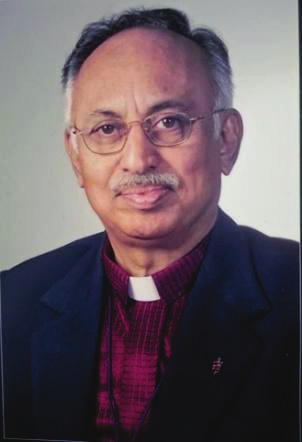 Bishop S.V. Sampath Kumar
Methodist Bishop in South India
Pastor of RTMC from 1969 to 1972 and Bishop of Bangalore & Madras Conferences from 1999 to 2007. Bishop Sampath Kumar has maintained a lifelong connection to the congregation. The historical material draws on his decades of research into the life and legacy of William Taylor.
