
Thirty-eight years at Richmond Town — an introspection
Som Thomas • Member, RTMC since 1987
It was August 1987. I was a freshly minted mechanical engineer, moving to South India after a lifetime in and around New Delhi. My YMCA neighbour and Cathedral School master, Mr. P.D. Julious, introduced me to RTMC, where I soon made other friends through shared student ministry connections. Having grown up in Mar Thoma and Church of North India churches, and later received adult baptism in yet another denomination, I finally found a home at RTMC — with its fine English-speaking Bible teachers in the pulpit and, in the pews, hymn books donated from 1960s America, all beneath century-old wooden rafters supporting a tiled roof.
In times of inner turmoil and insecurity during those youthful years, I found the old hymns and new choruses sung in the church as likely to speak to me as the messages from the pulpit. “The steadfast love of the Lord never ceases” might touch a quietly tearful me one Sunday, and my heart might agree another Sunday to “Oh, speak, and make me listen.” Those yearnings to feel loved, and to be able to serve, encountered a God who both heard and spoke. In my mind, I find it impossible to disassociate the RTMC of that time from many aspects of my young adult spiritual maturing.
On one Sunday in 1989, Pastor Michael Peppin began his sermon by saying he had preached on Romans 1 and 2 the previous two Sundays, and was now due to speak from Romans 3. However, he felt that someone needed to hear from John 11 that day. I have never forgotten the sense of God speaking directly to me through that message: “What do I do when God doesn’t do what I have been told He is expected to do?” It was a turning point in my learning to trust God’s loving purposes, always.
“I find it impossible to disassociate the RTMC of that time from many aspects of my young adult spiritual maturing.”
— Som Thomas
Pastor Peppin was also the one who spoke at our wedding — Shyni’s and mine — in 1990, solemnised by Rev. R.G. Soanes, a few weeks after the young assistant pastor Arun Andrews had tied a thali on Miriam. These were among the last weddings under the wood-frame roof, which was found to be structurally unsafe. The engineer in me wondered what an organisation funded by the steel industry knew about wooden beams and struts — but we contributed faithfully, nonetheless, to the rebuilding that followed.
Non-Christian neighbours protested in letters to newspapers as a heritage jewel of Richmond Town disappeared. The church brought out a souvenir magazine at the time, complete with an outdoor group photograph of the whole congregation taken at Baldwin Girls’ High School, whose Montgomery Hall became RTMC’s meeting place for the next two years.
The rebuilding project brought with it losses alongside gains — including the Matador van that had taken Dr. David and a Methodist Men’s team to the LR Nagar slum for medical ministry. The Tamil-speaking church at LR Nagar continues to serve with Rev. K. K. David as its current pastor, and the Kannada-medium school there produced one of India’s award-winning teachers in Mrs. Shashikala Natarajan. These are among the quieter achievements RTMC rarely publicises.
Like all institutional churches, the Methodist Church in India has had its seasons of difficulty: governance challenges, tensions between clergy and laity, and the perennial question of whether schools and hospitals are best run by those trained in ministry or by secular professionals who are themselves disciples. These are not unique to Methodism. The laity of any denomination are also, ultimately, its financiers — a responsibility that ought to carry some corresponding voice. What I have valued at RTMC is that the congregation here has, more often than not, managed to hold these tensions with more grace than is sometimes found elsewhere in the wider denomination.
Area Bible Studies, Sunday School, Education & Christian Nurture, VBS, and Evangelism & Missions are the areas in which I have been most involved. It was an older gentleman’s words — “Life is short” — that spurred me to take up Sunday School teaching. My happiest involvement came when a pastor allowed me to assist in Confirmation Classes — quite atypical of the clergy-laity distance that can sometimes prevail, and all the more valued for its rarity.
In the pulpit, RTMC has had some of the finest English-language preachers in Bangalore, and there were Sundays when no seating remained if one arrived even two minutes late. Not only did visitors flock to what many regarded as the best teaching church in the city, but distinguished guest speakers came too. There was a Visitors’ Book in which I saw the signature of Nicky Gumbel, founder of the Alpha Course. Others I remember include Sunder Krishnan, L.T. Jeyachandran, and Kenneth N. Taylor, creator of The Living Bible and author of a children’s devotional from my own childhood.
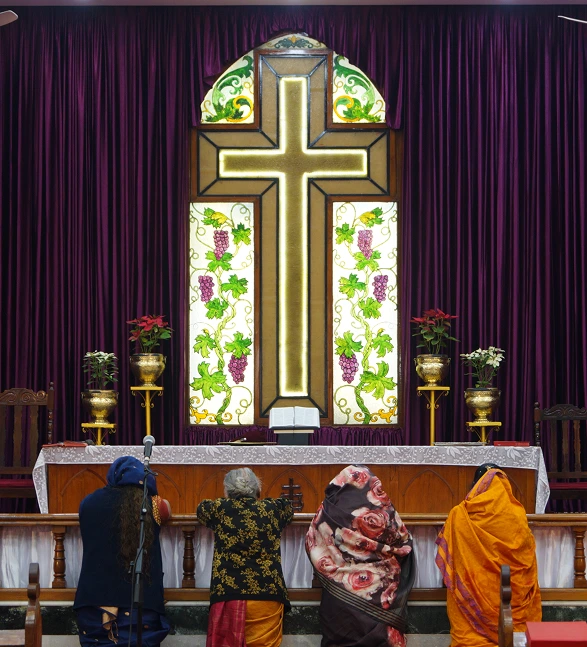
The opportunity to pray at the altar when one’s heart is bursting has often provided a genuine turning point. The power, of course, is not in the altar, but in the God who does not crush a broken reed. I have messaged thanks to pastors when their words, unknown to them, spoke directly to a heavily laden heart.
At the same altar, Communion is not an individualised experience but that of a community of sinners — meaning those served as well as those serving. This struck me particularly at the “restoration” service of Pastor Theodore Williams after his moral fall, subsequent confession, repentance, and years away. Apart from that sad phase, his sermons were among the most deeply thoughtful ever preached here.
The seminars RTMC conducts from time to time have drawn very high-quality resource people. One of the earliest I remember was a day-long workshop on evangelism — a forgotten topic in many churches. The passion to reach outward was also evident when a young pastor mobilised provisions for families evicted from EWS quarters near LR Nagar with very little notice. Even the briefest outreach leaves a lasting impression. I especially remember one visit to Accept, a home for adults and children dying of HIV.
RTMC is where we have found friends and many good pastors, who are there for us. What makes a church is not Sunday services alone, but the way relationships play out in the real world on all the other days. Advice from a pastor helped us decide quite crucially on school choice for our older son. The same pastor guided me into RZIM apologetics involvement. When Shyni and I were both simultaneously afflicted by prolonged medical emergencies in 2014, pastors visited us, and friends brought food home.
Between our two sons, we lost a daughter. The pastors of that season made all the difference — including the retired Dr. Thomas Gnanamuthu, who was a medical doctor, psychiatrist, Bible teacher, and counsellor, and who communicated things that brought peace on the saddest day of our lives. We were dabbling in another independent church at the time, but the sense of being so wholesomely served by these mature, selfless people in our weekday needs was so great that RTMC has remained home in the decades that followed.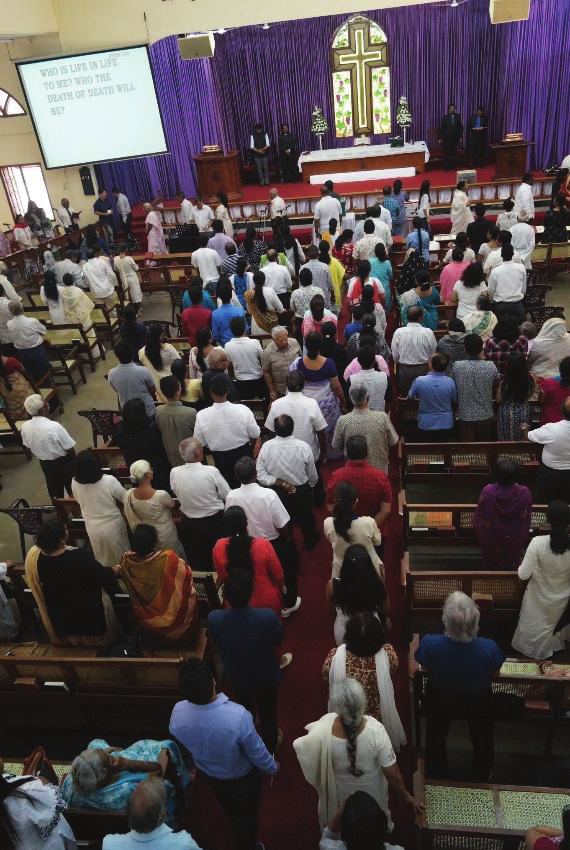
✞ It is unselfish fellowship by clergy and laity, shared prayers, and sound Biblical teaching (Acts 2:42) that keep a church alive for 150 years — and more.
— Som Thomas
