
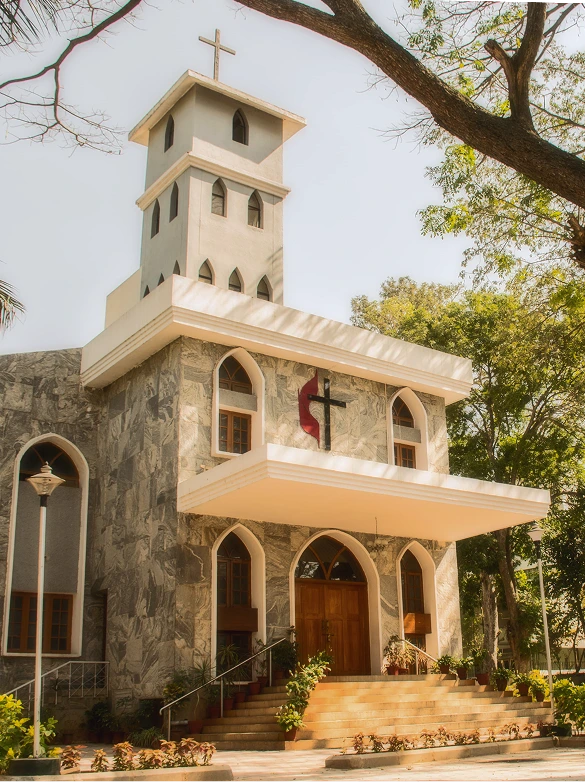
The Compound, the Lost Boy, the Wandering Youth, and What a Child Learns When Home Is a Church
By Rupen Paul • Son of Rev. K. Vasudevan, pastor of RTMC in the late 1990s
I should warn you that I intend to end this with a joke. I ask only that you stay with me until I get there.
My father, Rev. K. Vasudevan, was the pastor of Richmond Town Methodist Church in the late 1990s. My sister and I were both under ten years old. We lived in the parsonage, which meant that the church — its compound, its buildings, its daily comings and goings — was simply the world we grew up in. We did not think of it as special. It was just home.
Looking back now, I understand that it was rather special indeed.
The Compound and the Children Who Found It
The parsonage compound was large — large enough for two small children to run and play and cycle around it for hours without exhausting its possibilities. It felt, at that age, almost limitless.
Word gets out quickly in a neighbourhood when there is a compound like that. Children from the surrounding streets began finding their way in, befriending my sister and me, joining the games. Their parents would come to my mother:
“My daughter has no one to play with. Can she come and play with your children in the church?”
“My son has been asking to come. Would that be alright?”
These were not children from the congregation. They were from different faiths, different backgrounds, different parts of the neighbourhood.
What struck me, even then, was that none of that seemed to matter to them. They did not see the church as a place that belonged to a particular kind of person. They saw it as a place that was open — a space big enough for whoever happened to need it.
I did not have the words for this observation at seven years old. But I have thought about it many times since, and I think those children understood something that churches sometimes have to work hard to communicate: that the doors are open, and the compound is for everyone.
The Boy Who Lost His Way and Found the Church
One afternoon, while I was playing in the compound, a boy walked in through the gate. He was wearing the uniform of Baldwin Boys’ High School — my school. He looked about my age, perhaps seven. And he was crying.
We gathered around him and asked what had happened. He had been forgotten at school, he said — no one had come to pick him up. He had decided to walk home, but somewhere along the way he had lost his bearings entirely. He did not know where he was, or how to get to where he was going.
And so, finding himself in front of a church, he had walked in.
Also at the church that afternoon was Danny — the son of Rev. David Vijay Kumar. Danny took charge of the situation with a quiet steadiness that I still find remarkable when I think about it.
He spoke to the boy calmly. He walked him to the church office and helped him phone his parents. And then, while they waited for someone to come, Danny picked up his guitar and sang songs with the boy until the tears had dried and the anxiety had lifted and, eventually, his parents arrived.
“Even that boy who felt lost knew that the best place to go was the church. And Danny knew exactly what had to be done.”
— Rupen Paul
I have thought about that afternoon often. Danny did not have a programme for this. He was not following a pastoral care protocol. He simply saw a frightened child and responded with the two things that frightened children most need: practical help and the warmth of company.
The guitar was the right instinct. The songs were the right instinct. Staying with the boy until his parents came was the right instinct.
I do not know whether Danny remembers that afternoon. But I have never forgotten it. It is one of the clearest examples I know of what the church is actually for — not the scheduled, the organised, the programmed, but the unplanned moment of need that arrives at the gate and is received without hesitation.
The Youth Who Walked Around the Church Until Dark
There was another evening that has stayed with me.
A young man — a youth, I think, rather than an adult — arrived at the church compound and simply began walking around its perimeter. He was there when the afternoon was still light. He was still there when it grew dark.
I did not know, then or now, what he was carrying. Something with his family, something at home — whatever it was, it was clearly enough to make returning home feel impossible.
And so he walked around the church, in the way that people pace when they have nowhere to sit with what they are feeling, for as long as he needed to.
When my father came home that night, he noticed the young man still there. He went out and spoke with him. I do not know what was said.
But my father came back inside, collected some bedding from our home, and arranged for the young man to sleep in one of the church buildings.
A meal. A roof. A place to be without having to explain yourself, at least for one night.
These are not large things in themselves. But for someone who needed them in that moment, they were everything.
“We often think of the church as a place people frequent on Sundays. But there are also the days in between — when the church is still the church to those who have nowhere else to go.”
— Rupen Paul
What a Child Learns When Home Is a Church
Living inside a church — the only time in my life I have done so — taught me something that I think is harder to learn from the outside.
The church is not primarily the Sunday morning service, though that matters enormously. It is also the compound on a Tuesday afternoon. It is also the gate that someone walks through when they are lost. It is also the building where a young man can sleep when he cannot face going home.
The church belongs to the people who turn up on Sundays, yes. But it also belongs to the boy from another faith whose parents wanted him to have somewhere safe to play. To the child in the Baldwin Boys’ uniform who walked in crying. To the youth who paced the compound until dark.
These people were not members of the congregation. But the church was theirs too, in the moment they needed it. And it received them.
These are the adult reflections of a childhood I am very glad I had.
But I want to end, as I promised, with something lighter.
When I think back to those years with the feeling I had as a child rather than the understanding I have as an adult, what I remember is not the lost boy or the wandering youth.
What I remember is the happiness: the running and the cycling and the making of new friends and the shouting that we did until we were sure we had brought the roof down.
Which, as it happens, once actually occurred. The parsonage was quite old.
